Behind the Book: Slaughterhouse-Five
It took Kurt Vonnegut 23 years and 5,000 pages to write a 200-page book about the worst thing he ever saw.
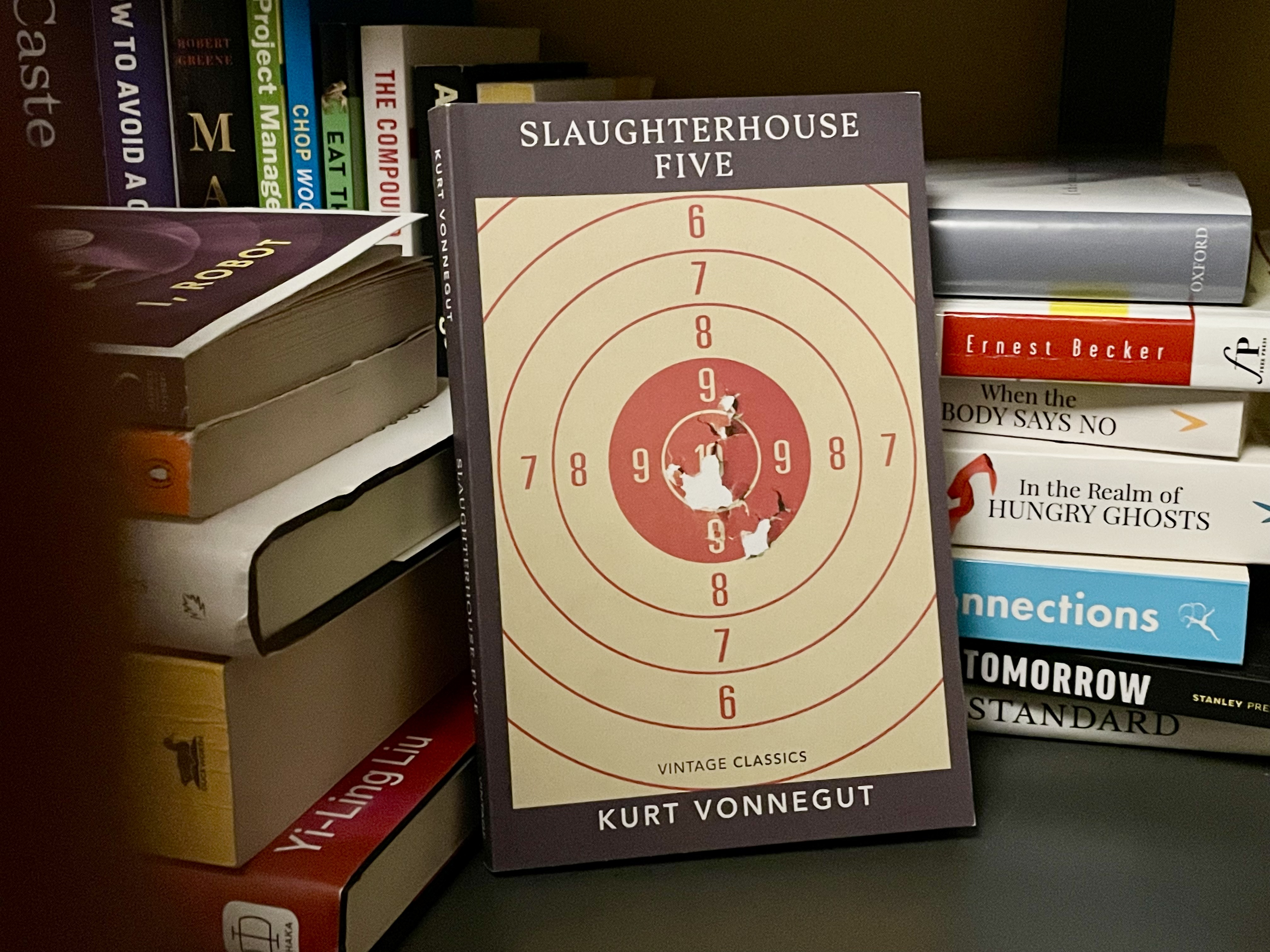
23 Years of Failure
It took Kurt Vonnegut 23 years to write Slaughterhouse-Five. Twenty-three years. He wrote thousands and thousands of pages. He threw them all away. He went through at least 18 different openings. The main character changed name from Harold Moon to David McWan and finally Billy Pilgrim. In one draft, Billy was a gay car salesman. In another, Vonnegut tried to write the whole thing as a movie for Kirk Douglas.
None of it worked. For 23 years, one of the greatest writers in American history couldn't figure out how to tell the story of the worst thing he ever saw.
This is the story of how Slaughterhouse-Five got written.
Indianapolis to Dresden
Kurt Vonnegut grew up in Indianapolis. In late 1942, he enlisted in the war and was sent to fight in Europe. On Mother's Day 1944, he got leave to go home — and that same day, he found that his mother had killed herself. She overdosed on sleeping pills. He was 21 years old.
Three months later, he was shipped overseas just in time for the Battle of the Bulge, the last major German offensive of the war. His entire division was wiped out. Vonnegut was captured by the Germans.
The Germans packed their American prisoners into boxcars and shipped them east to Dresden. It was the first beautiful city Vonnegut had ever seen. He called it "the first fancy city he had ever laid his eyes on." They put the prisoners in a slaughterhouse. Slaughterhouse Five.
The Firebombing
Every day, Vonnegut went to work in a malt syrup factory. At night, he slept in the slaughterhouse. On February 13th, 1945, the air raid sirens went off in Dresden.
Vonnegut, some other POWs, and their German guards ran into a meat locker three stories underground. It was cold down there. Cadavers were hanging all around them. Above them, Allied bombers dropped incendiary bombs. The entire city caught fire. Firestorms killed an estimated 25,000 people.
Dresden was incinerated. Hospitals, churches, homes, families. Vonnegut survived because he was inside a meat locker underneath a slaughterhouse.
The next morning, he climbed out of that hole and walked into a city that no longer existed. Everything was ash. Bodies were everywhere — in the streets, piled up in homes where whole families lay dead. His surviving captors put him to work. His new job was to find, carry, and burn the dead. He did that until the Russians came and ended the war.
"The sons of bitches. The sons of bitches."
When Vonnegut came home and told his family what happened, he was crying. That was the last time he ever talked about it — for 23 years.
📺 Watch the Video
Two Decades of Crap
Vonnegut got home and, like millions of other veterans, tried to get on with his life. He worked as a newspaper reporter. He did PR for General Electric. He started writing science fiction novels — Player Piano, The Sirens of Titan, Cat's Cradle.
But the whole time, there was this thing he couldn't write. The thing he actually needed to write. The Dresden book.
He tried. God, he tried. He wrote over 5,000 pages about Dresden in 1965. He threw it all away. One early draft, called Magic Fingers, was about a Dresden survivor who visits his old army buddy and is obsessed with those coin-operated vibrating hotel beds. Another ran over 130 pages and was about Billy Pilgrim selling Pontiacs in the Midwest — no real plot, no dramatic pull.
"It was a hack. I'd write anything to make money, you know, and what the hell? I've seen this thing. I've been through it. And so I was going to write a hack book about Dresden." He paused. "I tried, but I just couldn't get it right. I kept writing crap."
And he wasn't being modest. In the archives at Indiana University, you can find hundreds of pages of discarded drafts. Eighteen different openings. Characters that go nowhere. Stories that don't connect. The man who could write one of the greatest novels of the 20th century spent two decades writing, by his own admission, garbage.
Vietnam Changed Everything
In 1967, Vonnegut went back to Dresden. He took his old army buddy, Bernard O'Hare, with him. They walked through the streets of the city that had been rebuilt after the war. He was doing research. He was going to take one more run at the book.
And then something happened. The Vietnam War happened.
"I think the Vietnam War freed me and other writers because it made our leadership and our motives seem so scruffy and essentially stupid. We could finally talk about something bad that we did to the worst people imaginable, the Nazis. And what I saw and what I had to report made war look so ugly. You know, the truth can really be powerful stuff."
Vietnam gave him permission not to write about Dresden as a heroic war story — he had been failing at that for 20 years — but to write about it as horror, as an absurdity, as something that broke a man so completely the only way to process it was to become unstuck in time.
Less than 10 months after returning from Dresden, Vonnegut turned in the final manuscript. He mocked it immediately. In a letter to a friend, he wrote:
"It sure has been hard. It wasn't very long. From now on, I'm going to follow familiar models and make a lot of dough."
His editor reportedly didn't change a single semicolon.
So It Goes
Slaughterhouse-Five was published on March 31st, 1969. The same month, American soldiers were still dying in Vietnam. It was an instant bestseller. It made Vonnegut a cult hero. It became one of the most banned books in American history.
The book is barely 200 pages. It is short because, as Vonnegut says in the first chapter: "There is nothing intelligent to say about a massacre."
Twenty-three years and 5,000 pages compressed into something small, observed, and devastating.
So it goes.
💡 Why This Story Matters
Every person who creates anything has a version of this experience. Not the war, not the trauma — but the thing you can't get right. The project that matters so much that you keep failing because no version feels worthy of what you're trying to say.
Vonnegut wrote thousands of pages over 23 years. The version he finally released wasn't the one with the perfect structure or the perfect characters. It was the version where he stopped trying to write the story correctly and just admitted that war is absurd, time is broken, and there's nothing intelligent to say about a massacre.
Sometimes the breakthrough isn't getting better at your craft. It's getting honest about what you actually think.