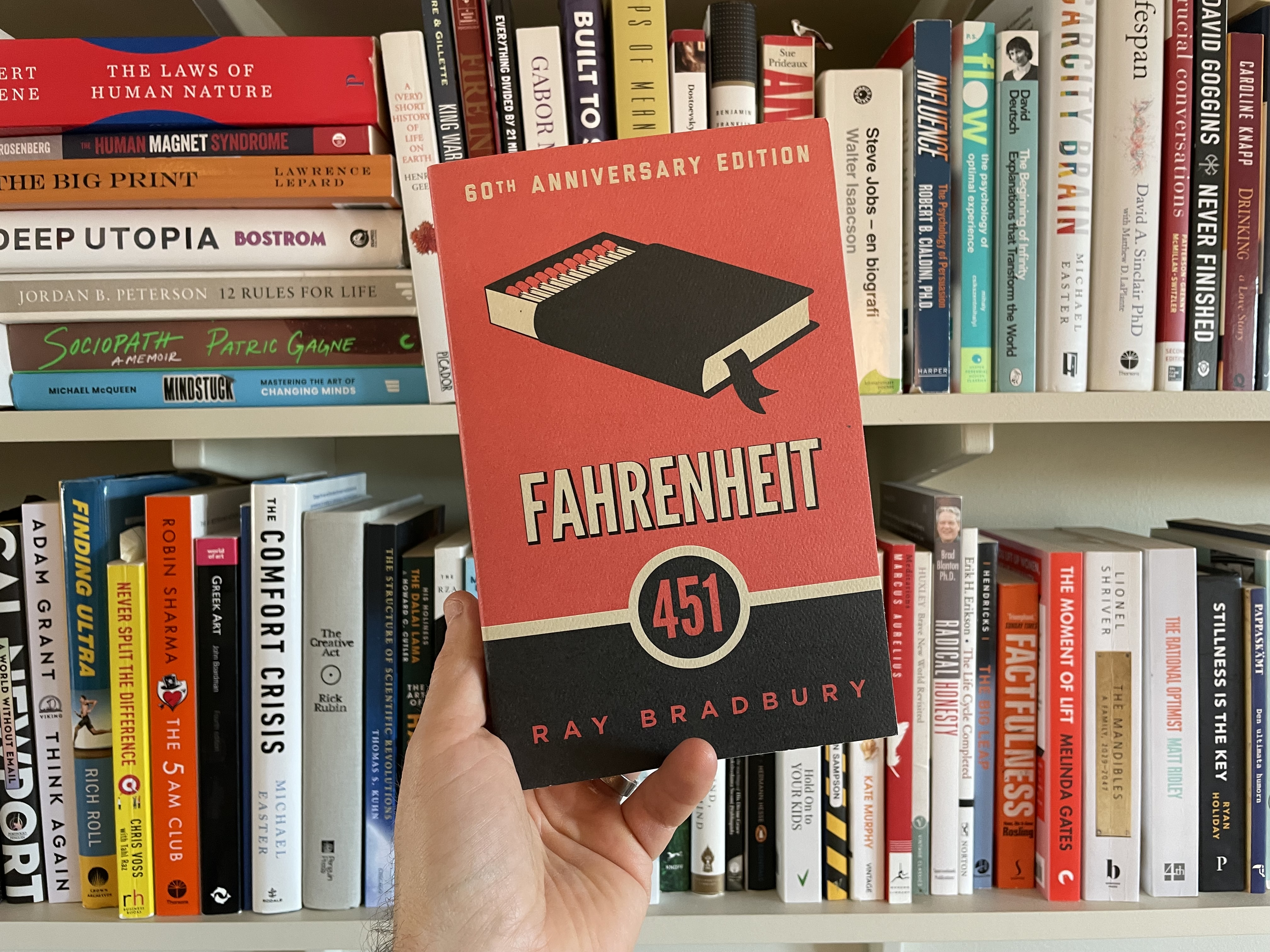
Fahrenheit 451
The book that predicted we'd stop reading — not because they banned books, but because we preferred to scroll.
The Scene That Changes Everything
A fireman walks into a building — not to save anyone, but to burn books. He tells the woman standing in her apartment to drop the book she's carrying, but she won't. She holds on to it and stares him down. The other firemen don't have all night. There are other addresses, more books to burn. So they torch the place with her still inside.
And the fireman, Guy Montag, is standing there watching this woman being burned alive. All he can think is: what could possibly be inside these books that makes people protect them with their lives?
That scene cracked something open in him. And honestly, it cracked something open in me too. That's when I knew this book was going to hit differently.
A World Without Books
Published in 1953, Fahrenheit 451 is a classic that most people have heard about but not everyone has actually read. The number 451 refers to the temperature at which paper catches fire. It's a short read — only 150 pages — but it packs a punch.
The world Bradbury creates is one where books are illegal. Firemen don't put out fires — they start them. Since all housing is fireproof, there's no need for traditional firefighting. Instead, firemen find books and burn them. People spend their days watching wall-sized TV screens, connected with earbuds called "seashells," numbed out on shallow entertainment. Nobody reads, nobody thinks, and most people are perfectly fine with that.
How It Happened
Here's the part that got me. There's a scene where Montag's boss, Captain Beatty, explains how all of this came to be. And the key insight is this: the government didn't ban books first. People simply stopped reading them.
Beatty describes how everything kept getting faster and faster. Books got shortened into condensed versions, then digests, then 15-minute radio summaries. Everything got boiled down to the quick take, the snap ending, the punchline.
Sounds familiar? Because I'm sitting here reading a book from 1953 and I think about TikTok. I think about YouTube Shorts. I think about people commenting on X: "Hey GPT, can you summarize this tweet?" We are living in the early chapters of this book.
"Bradbury didn't predict that a government would start burning books. He predicted that the culture would voluntarily stop reading because they preferred to scroll."
📺 Video Review
The Girl Who Was Actually Alive
There's this character, Clarisse. She's Montag's young neighbor and she's completely different from everyone else in this world. She actually talks to people, notices things — the dew in the grass, the man on the moon. She asks Montag a simple question: Are you happy?
And it wrecked him.
It reminds me of a story from my own life. I had a colleague who irritated me for no particular reason. He was always relaxed, always had time to chat, nothing seemed to bother him. Meanwhile, I was always short on time, always needing to hurry. I was frustrated and often annoyed.
At some point I realized I wasn't annoyed with him. I was jealous. He had something I didn't — something I wanted to be but was unable to.
Carl Jung had a great line about this: "Everything that irritates us about others can lead us to an understanding of ourselves." That's the shadow — the idea that we project things we dislike about ourselves onto other people.
I think Montag felt something similar when he met Clarisse. She was really living and he was not. It made him uncomfortable, even angry. He hadn't made the connection yet. He just knew that something about her presence made his own emptiness unbearable.
A Quick Note on Benjamin Franklin
According to the book, the fireman's official rule book claims that the first fireman in America was Benjamin Franklin and that he wrote the guide on burning people's books. I was like — what? Benjamin Franklin, one of my favorite historical figures?
Of course, that's exactly the point. Franklin actually started the first voluntary fire departments in Philadelphia — departments that put out fires. He was also a huge proponent of reading and funded libraries. Bradbury turns this completely on its head as a way to show how easily history gets rewritten when books are destroyed.
Is Bradbury Right?
I have tremendous respect for Bradbury's work, and I think his warning about a world getting faster and more shallow is real. But I also want to push back a little.
Bradbury's warning is essentially: we're heading toward a world where nobody reads, nobody thinks, and entertainment replaces meaning. There's truth to that — but the picture is more nuanced than pure doom.
Today, we have broader access to information than any generation in history. We have three-hour podcasts about philosophy. Open libraries. Audiobooks. Deep discussions and articles on any subject you want. The question is — will people read it? And I think the answer is yes. More than we give ourselves credit for.
There have always been uncultured sections of the masses. That's not new. What is new is that the curious ones now have infinite access. Bradbury worried about the bottom dropping. But I think the ceiling has risen too.
💡 Key Takeaway
The most chilling insight in Fahrenheit 451 isn't that governments burn books — it's that people voluntarily stop reading them. Bradbury's dystopia didn't start with censorship. It started with speed, convenience, and the slow erosion of attention. The parallel to our world of infinite scrolling and AI-generated summaries is impossible to ignore.
⚖️ Verdict
Should you read Fahrenheit 451? Absolutely. It's short, sharp, and it will make you uncomfortable in the best possible way. If you've ever found yourself scrolling and wondered where that hour went, this book is a mirror right in your face.
It's not the best book I've ever read — the characters are a bit shallow and the pacing is uneven. The opening is stronger than the later parts. But as a sci-fi classic and a warning about the pace of modern society, it's a great weekend read. The audiobook version is excellent too — the kind of book you can finish in one sitting on a long drive.
🔍 Behind the Book
How did Bradbury write this in nine days for $9.80? The story of a coin-operated typewriter in a library basement, McCarthyism, and a publisher that censored its own anti-censorship novel for 13 years.
Read the Story →