The Great Work of Your Life
A guide to finding your dharma - your true calling - built on the timeless wisdom of the Bhagavad Gita.
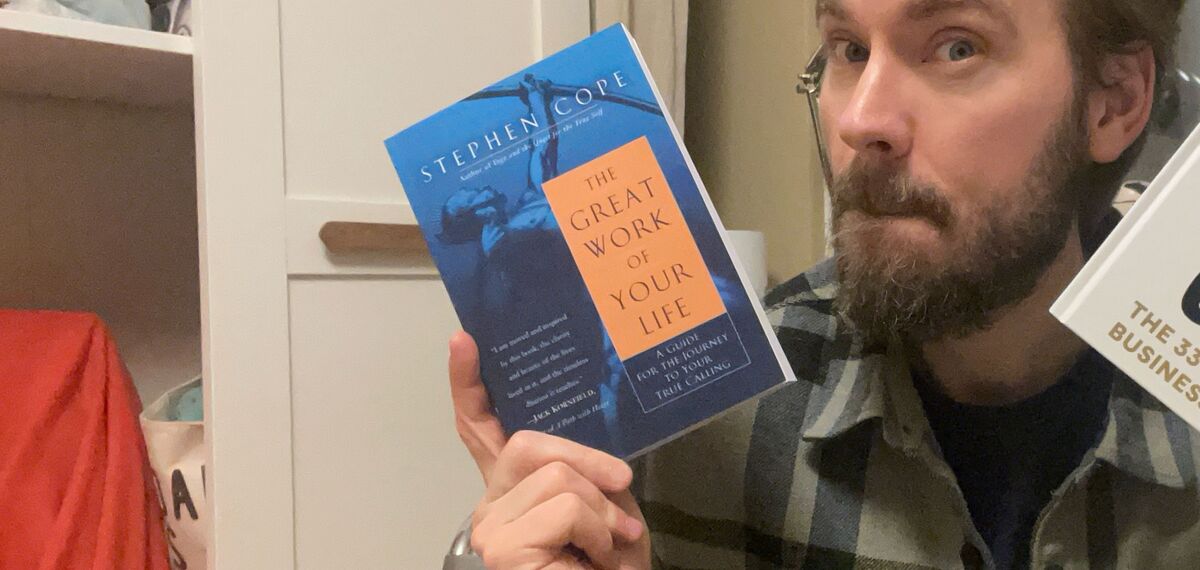
What Is This Book About?
This book is about finding your life's work, your dharma, your vocation, your calling. It's highly inspired by the Bhagavad Gita - an ancient Hindu scripture that has inspired people across the world for ages. It's not an ordinary book. It's a book that has given spiritual nurture to so many people and many prominent figures as well, such as Thoreau, Gandhi, and Oppenheimer, just to name a few. It's also a cornerstone piece in the yogic tradition. A book I urge everyone to read.
What Stephen Cope does here is take inspiration from the Gita and bring it into context by telling stories about famous people who found their dharma as well as regular people who took steps towards their life's work. So it's a mix of both.
So What Is Dharma?
In this context, it's a work or activity that aligns with who you are, that uses your unique abilities. This is the type of work that doesn't feel like work to you. It could be that you love to help people so you become a nurse, or you master your skill and become the best juggler in the world. Or maybe you want to take on society as a whole and move it in another direction.
"People actually feel happiest and most fulfilled when meeting the challenges of their dharma in the world. When bringing highly concentrated effort to some compelling activity for which they have a true calling."
But the problem is it's hard to find your dharma. So how do you go about finding it?
Finding Your Dharma
This is the tricky part. Where do I look for it? Oftentimes hints about your dharma can be found in childhood fascinations, your traumas, or your fears.
My own first step towards my dharma was when I became fed up with my dead-end job as a store clerk, filling up grocery shelves day in and day out, and I just had it at one point. I knew I really needed to quit. I needed to get out of there but where would I go? So I looked back in the past, trying to find what I actually had a natural curiosity about and what was fun to me. And I remembered back in school, we had a multimedia class where we built this big video game level of our school. And that work, that 3D work in creating that virtual environment, was one of the most fun projects I ever partook in. I didn't want to go home when the school bell rang.
So there was my hint. I was going to be a game developer. I had no prior skills or anything. I had no idea how to become one. But following that lead, I eventually made it there through many hard years of work. I followed that trail and ended up spending 15 years working in this field that really fascinated me, that was a source of flow and very fulfilling work in general.
Fear as a Compass
Fear could also be an indicator of dharma. I've always wanted to be able to share my ideas with other people, maybe publicly even. The problem is that I've been scared shitless to stand in front of a crowd or be at the center of attention in any way. I shied away from that. And at some point I realized this was problematic for me. This was an obstacle I needed to overcome, and that became obvious when I felt like I wanted to share what I've learned from books - what I do here on BookLab - and I really was not able to do it.
So I signed up for a course called Toastmasters where you can practice public speaking by doing several speeches in front of people in the club, over and over and over again. It was really hard and stressful for me. But at some point the fear started to become subdued and I was able to start this channel. You see the point here? The fear is trying to tell you something. It tries to tell you that something is important to you and that you need to address whatever is stopping you.
"What you fear is an indication of what you seek."
📺 Video Review
Trauma as a Guidepost
Trauma could be another guidepost on your path to dharma. What happened to you that allows you to, in a unique way, help others avoid ending up in the same place or to help them heal? There's a lot of energy bound up in trauma, and if you can find a way to channel it in a good and positive way, there's a lot of meaning that can come from that.
"If we live another person's dharma, or a dharma that is false to us, at some point we wake up to the fact that the only person who truly cares what we do with our lives is you."
When You Find It, Commit Fully
The book talks about the search for dharma, but also what to do when you find it. When you find it, you have to lean in and commit. But we also have to recognize that dharma is not a destination but a journey. Sometimes dharma runs its course - like when game development no longer fulfilled me in the same way and something else, something new, came into view. Like lifelong learning and understanding, for instance.
Transition is hard. You're at a crossroads, and that's when metaphorically you need to sit down in your folding chair and listen. What is right for me? And many people get stuck at this crossroads and never take the next step. You never have perfect information. You can't wait until you're 100% certain before you start the next thing. That's important. Life is short. Try things, pick a path, and be ready to pivot.
And when you do commit, commit fully. Clear away distractions. Simplify everything and aim everything towards that meaningful activity. Say no to what doesn't align with your dharma. Go all in.
This part of the book was fantastic. The part about committing to your dharma. And this is where we got some really good stories, especially the examples of Robert Frost and Thoreau and how they fully committed to their dharma.
"Boldness has magic in it. Whatever you can do or dream you can do, begin it."
And on Frost, the author says: "His dharma required him to farm, so he bought one. His dharma required him to give up teaching, so he did."
Another favorite part of this book is the story about Gandhi and how he fully committed to his mission. He simplified, he unified, he aligned his life in accordance with his dharma. If that story grabs you, I really want to recommend The Story of My Experiments with Truth by Mahatma Gandhi. I really love that book because it tells the story straight from the horse's mouth - how Gandhi experimented with this and that on his way to finding his calling in the world. It's fascinating following his process, especially knowing where he would end up later on.
And then there's Beethoven, who continued to compose even though he was going deaf, and he was going at it like a mad hound. These are the type of stories you'll hear from this book. Some are more interesting than others depending on your taste. But hearing about Gandhi and Beethoven and these extremely committed people - that was really and truly inspiring for me.
💡 Key Takeaway
My favorite lesson comes from the Gita, and it's about outcome independence when you commit to whatever your calling is: "Let go of the fruits of your action. You have the right to work, but never to the fruit of work." A slippery but beautiful idea. We are told never act for the sake of a reward, but also don't avoid action. Perform your work rooted in your deeper self. Calm in both success and failure.
⚖️ Verdict
I found The Great Work of Your Life being a great book for refocusing. It makes you ask: am I spending my energy in the right way? Am I fully expressing my curiosity, creativity, and my unique contributions to the world? It's a great introduction to the Bhagavad Gita, and when it comes to what you're supposed to do in your life, it's a great book for anyone feeling a bit stuck, maybe doing a dead-end job and wanting to find a path forward. It's an enjoyable book. It's a BookLab recommendation.