The Birth of Tragedy
A 24-year-old professor's radical theory about the forces that created — and destroyed — the greatest art form in history.
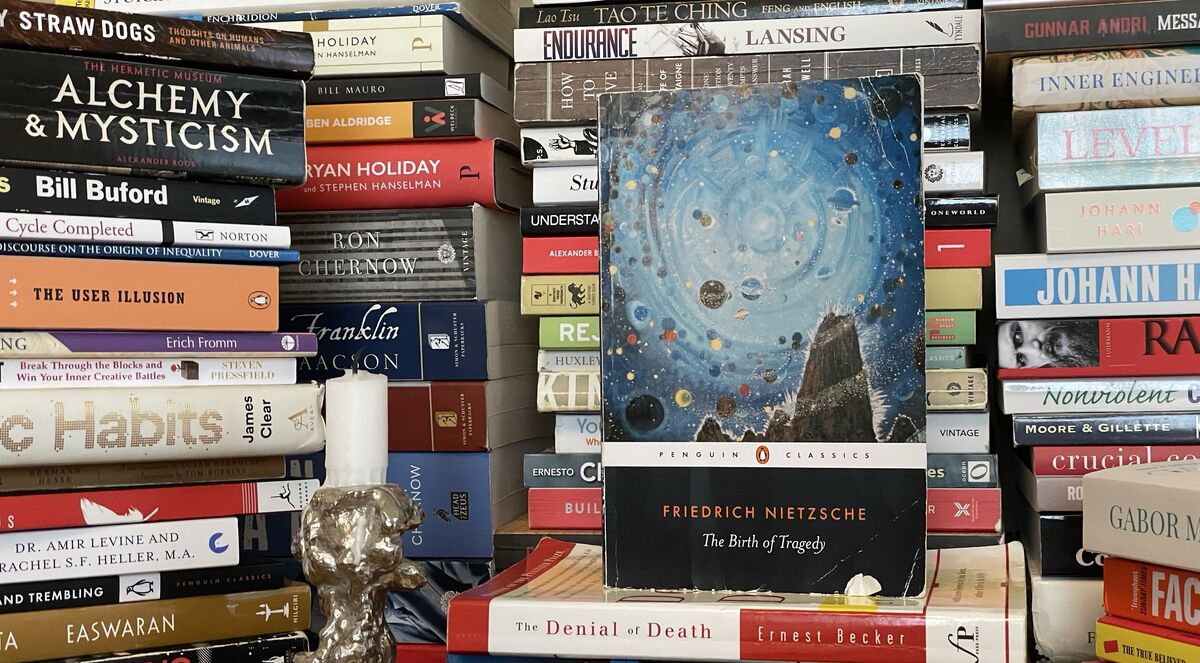
A Birth of Tragedy in 7 Steps
Nietzsche is 24 years old when he becomes a professor of philology. In 1872 he writes his first great book on dramatic theory: The Birth of Tragedy. And it's a wild one.
He found an art form in the classic Athenian tragedy that transcended the nihilism and horror of a meaningless world. What he discovered was an opposition between two forces — the Dionysian and the Apollonian.
The Attic tragedy balanced these forces and allowed the spectator to experience the full weight of the human condition. Beautiful works of art — the Apollonian — compensated for the horror of existence.
"To see science under the lens of the artist, but art under the lens of life."
The Villain of the Story
The end of tragedy came with Socrates, through Euripides, who Nietzsche thought ruined the Dionysian/Apollonian balance by bringing reason and logic onto the stage. That was the final blow against the Dionysian spirit.
Science, Nietzsche argues, is the total antithesis of culture. When science takes over, it sterilizes culture out of existence. The Socratic man is the avatar of science — a destructive force for everything that makes art alive.
📺 Video Review
Aesthetic Arrest
There's a concept from Schopenhauer that runs through this book: aesthetic arrest — freedom from the Will in experiencing a great work of art. The only time, except Nirvana or Samadhi, where man can be free from the Will, which is purely concerned with the economic. It's that moment when a painting or a piece of music stops you dead and the world falls away.
Is dancing and shouting in a drunken madness to "Killing in the Name of" a form of modern Dionysiac phenomena? 🤔 I think Nietzsche would say yes.
A Rebirth Through Music
Nietzsche found new hope in Wagner's music as a way to re-establish the balance between the Dionysian and Apollonian in modern art — a possible rebirth of tragedy. The inquiry's goal is to "understand the Dionysiac-Apolline genius and its works of art, or at least gaining a sense of the mystic union."
Even Nietzsche himself, looking back 16 years later, was brutally honest about the book: "Today I find it an impossible book — badly written, clumsy and embarrassing... so sure of its convictions that it is above any need for proof."
💡 Key Takeaway
I've gotten through a book that is "out of my league" and came out on the other side with new-found confidence in my ability to read philosophy straight from the sources. A proven book — one that was good enough for the best minds of the day.
⚖️ Verdict
I got a lot of value from this book, both as an introduction to Nietzsche and to the concept of the Dionysian/Apollonian opposition. But if you're unsure whether you could stand 129 pages of analysis of Ancient Greek theatre and art theory — then you should probably pass on this one.