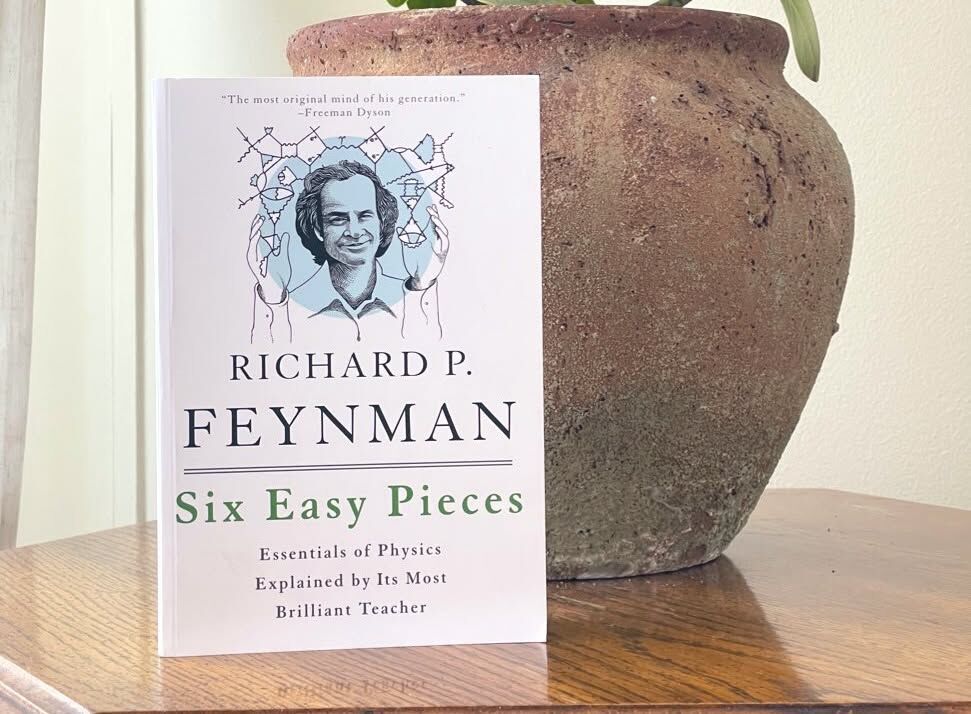
Six Easy Pieces
Feynman makes the laws of the universe feel like a conversation with the smartest friend you've ever had.
The Legendary Lectures
Richard Feynman was one of the most prominent physicists of the twentieth century, with a focus on quantum mechanics and theoretical physics. But he wasn't just a genius in the lab — he was passionate about teaching. He saw beauty and excitement in the subject and wanted to reach more people, to inspire the next generation of physicists. To do that, he developed a teaching style built on vivid analogies, relevant real-world examples, and a dash of humor.
Six Easy Pieces is based on Feynman's now legendary lecture series on basic physics at Caltech. This book contains the first six lectures from that series — supposedly the "easy" part. But here's the thing: these lectures were originally designed for the most intelligent students at a prestigious university, and even the most ambitious among them ended up scratching their heads as Feynman went deeper. So "easy" — like time itself — is relative.
What the Book Covers
Feynman starts with the most basic theory: the atomic theory. From there he moves on to basic physics, energy, gravitation, quantum mechanics, and the relationship of physics to other topics — all without making things convoluted or using unnecessarily big words.
The most fascinating part of the book is Feynman's explanation of quantum phenomena. I knew that light acts both as a wave and a particle, but when I got Feynman's explanation, it was the first time I truly understood how that works. I also really enjoyed getting a primer on atomic theory and the law of thermodynamics — how on an atomic level water turns into ice, and how that makes the water expand. Feynman makes it click.
📺 Video Review
Why First-Principles Thinking Matters
My journey into reading started with an interest in human nature — why we are the way we are. That obsession has fueled BookLab for over a decade. But as the years go by, I've noticed myself gravitating more and more towards the real fundamentals: math, physics, biology — the stuff that sits at the core of all things.
The reason I find books like Six Easy Pieces so important comes from an insight I got a few years ago when I started to understand the importance of reasoning from first principles. First-principles thinking involves breaking down complex problems into fundamental truths and basic principles. This kind of thinking has improved my reasoning abilities and decision-making immensely. It sounds like common sense, but most of the time we don't do it — we just study surface phenomena instead. And studying the laws of physics is not only important for scientists. It is fundamental knowledge of how things operate. The laws of physics operate whether you like it or not, whether you know about it or not. It's inescapable.
Timeless Prose
It's been over sixty years since Six Easy Pieces was published. Our understanding of the universe and quantum mechanics has evolved enormously since then. But never did I feel like this book was out of date — rather the opposite. It felt timeless. Feynman's unique way of teaching and his beautiful prose make nature feel alive, vibrant, and inspiring. It was just such a joy to read. What a legend this guy was.
"If, in some cataclysm, all of scientific knowledge were to be destroyed, and only one sentence passed on to the next generation of creatures, what statement would contain the most information in the fewest words? I believe it is the atomic hypothesis."
To be honest, some parts went above my head. I allowed myself to be confused and just continued through it. And that's part of the beauty — this is a book you can return to, and each time it'll give you more. It's books like this that make being an avid reader and a lifelong learner such a rewarding experience.
💡 Key Takeaway
The laws of physics are not optional knowledge reserved for scientists — they are the fundamental operating system of reality. Understanding them, even at a basic level, gives you the building blocks for first-principles thinking that improves reasoning and decision-making across every domain of life.
⚖️ Verdict
If you want to understand the fundamentals of how the universe works — explained by the greatest physics teacher who ever lived — this is your starting point. Feynman's prose is alive and warm in a way that no textbook has ever been. Some passages will fly over your head, and that's fine. The joy is in the journey. A must-read for anyone who values thinking from first principles.