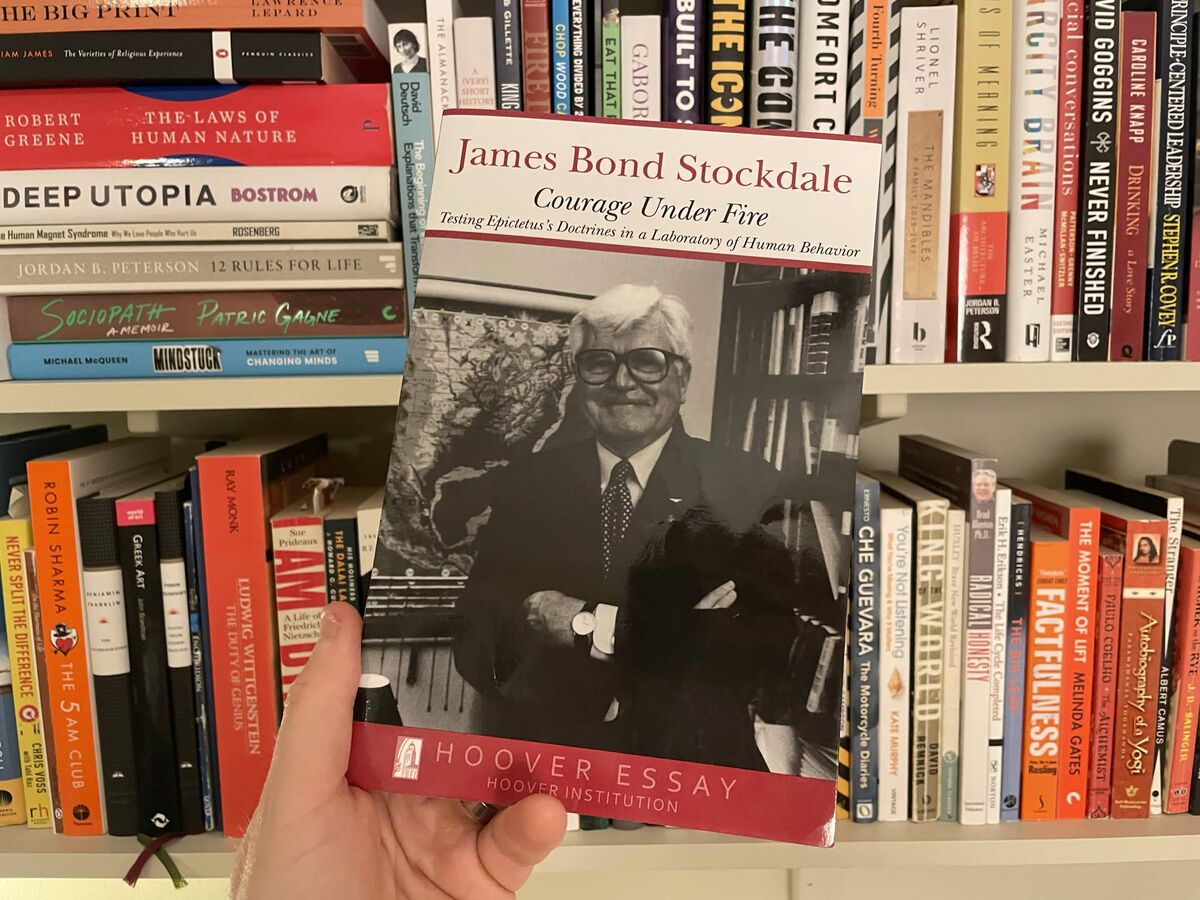
Courage Under Fire
A 21-page essay that proves philosophy isn't abstract — it's survival.
The Story
It's insane how much impact one single book can have on one's life.
James Bond Stockdale was an American fighter pilot who found philosophy late — at the age of 38. On the last day of his philosophy studies, his mentor Phil Rhinelander reached high on his wall of books and brought down a copy of the Enchiridion by Epictetus, the ancient Stoic philosopher. "I think you might be interested in this," he said.
Stockdale devoured it. He studied it for years. And then he was called back to war.
He fought in Vietnam. His plane was shot down. And for eight years he was held as a prisoner of war — enduring torture and isolation, interchangeably. It was during this time that what he learned from Epictetus really helped him survive.
"I whispered to myself — five years down there at least. I am leaving the world of technology and entering the world of Epictetus."
Philosophy as Survival
In prison, Stockdale took charge. He and the other POWs developed their own attitude to their situation — a code of conduct based on what Epictetus prescribes. And in his story we learn what really breaks a man, and how important philosophy can be once it's truly embodied and lived out in the real world.
The thing that brings down a man is not pain — but shame.
One pillar of Stoic philosophy is the dichotomy of control. Stoics separate things into two categories: things that are within our control, and things that we don't have control over. You focus all effort on what's in your control — your aims, your opinions, your judgments, even your aversions, griefs, and joys. The attitude you choose to have in life. Your own definition of good and evil.
📺 Video Review
What Makes It Special
The book is thin — probably the thinnest book I've ever reviewed. It's 21 pages long. But it's a powerful read. To embody one's philosophy, to walk one's talk, is a rare and precious thing. And that's what makes Stockdale's experiment with Stoicism under torture so special — because it's at the extremes of a spectrum where human nature shows its true face, and where we can learn the most about what it means to be human.
"Show me a man who though sick is happy, who though in danger is happy, who though in prison is happy, and I show you a Stoic." — Epictetus
Reading this book made me realize how far I am from the Stoic ideals myself. But you can only get better from here. And it almost brings me to tears to think about how one single book — in this case, the Enchiridion — can change a man's life in such a profound way.
💡 Key Takeaway
Philosophy isn't an intellectual exercise. When everything is stripped away — freedom, dignity, comfort — what you believe and how deeply you've internalized it is all you have left. Stockdale proved that Stoicism works not as a lifestyle accessory, but as a survival tool in the most extreme conditions imaginable.
⚖️ Verdict
The book's major flaw is that it's too short. The writing style takes a little getting used to. But otherwise, this is a strong, strong read — and one of the most powerful accounts of applied philosophy ever written. If you've ever wondered whether philosophy actually matters when things get real, Stockdale answers that question definitively. Yes. It does.