A Brief History of Time
The most bought but least read science book ever written — and after two reads, I kind of understand why.
What's It About?
Time travel, the beginning of the universe, wormholes, and string theory. Considering the complexity of some of these topics, it's strange that the book has become an international bestseller. Though, I read somewhere that it's one of the most gifted books — but also the least read. Having gone through it twice now, I can see why on both counts.
Hawking takes you on a tour of the biggest questions in physics: Where did the universe come from? What is time? What happens inside a black hole? Can we travel backwards through time? It's ambitious as hell, and when it works, it really works.
The Good Stuff
Most fascinating to me was learning about the Event Horizon — the boundary of a black hole, the point of no return where not even light escapes — and the Thermodynamic Arrow of Time. The idea that entropy, the increase of disorder, is what distinguishes the past from the future. That's what gives time its direction.
"The increase of disorder or entropy is what distinguishes the past from the future, giving a direction to time."
And then there are those moments where Hawking hits you with something that makes you stop and stare at the ceiling. Like the fact that children dare to ask questions adults don't: "Why do we remember the past and not the future?" Be more like a child.
Or this gem: "There could be whole antiworlds and antipeople made out of antiparticles." My mother used to tell me I shouldn't be so "anti" everything when I was a teen. I guess I was one of the antipeople Hawking talked about.
However — if you meet your antiself, don't shake hands. You would both vanish in a great flash of light.
Where It Loses Me
The book is inconsistent in many ways. Some of the more basic concepts of physics are described at length, while complex and abstract ideas get less than a page. You'll get a whole chapter easing you into Newtonian mechanics, and then Hawking will casually blow through quantum gravity in a couple of paragraphs like it's nothing.
I also think it's weird that the concept of God pops up here and there with little or no reason. Maybe it's a bit of hubris on Hawking's part — the physicist who can't resist poking at theology.

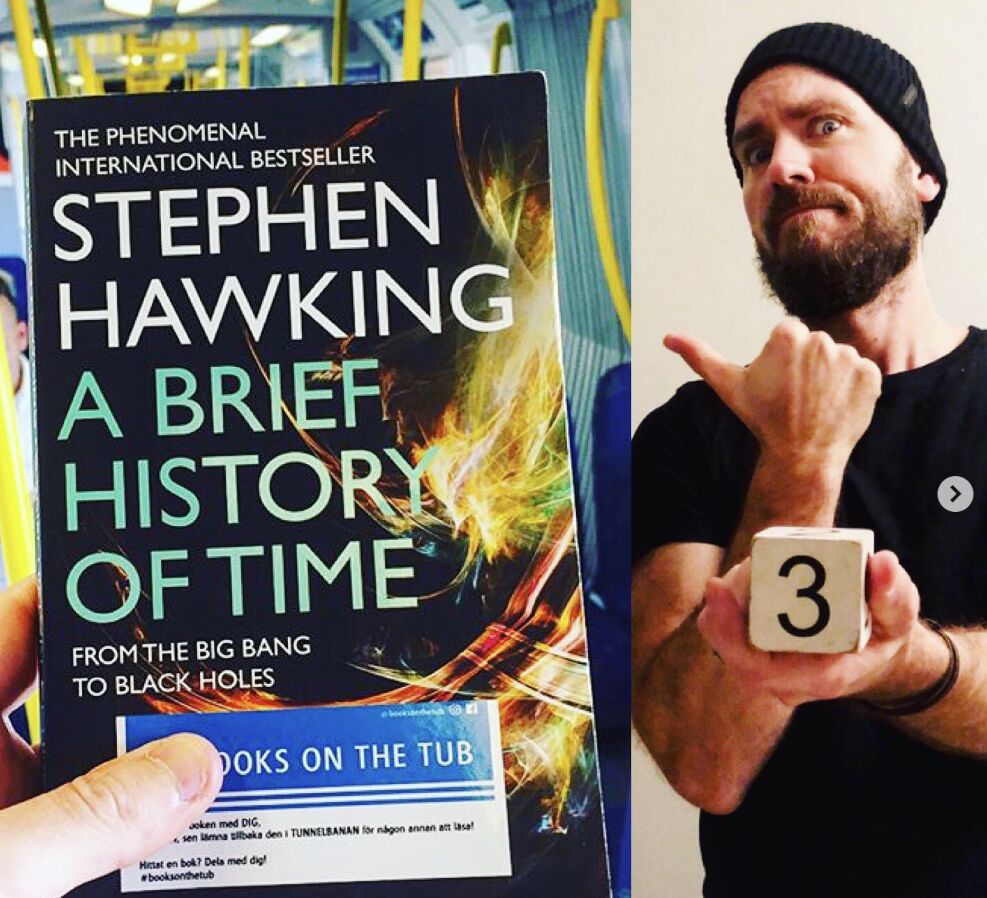
Left my old copy in the Stockholm subway after finishing it. Everyone too distracted to notice. Classic.
💡 Key Takeaway
Humanity's to-do list remains the same as when Hawking wrote it: come up with a complete and consistent theory that combines quantum mechanics and gravity. We still haven't checked that box. But understanding why it matters — why the very small and the very large don't play by the same rules — is what makes this book worth the struggle.
⚖️ Verdict
I've read it twice now, and it was actually harder to follow the second time. Probably because I did it on audio, and the complicated ideas — at least for my limited understanding — made more sense when they were accompanied by pictures, graphs, and illustrations.
I think there are more accessible books on the topic that beginners like me should prioritize. Deep Simplicity by John Gribbin covers similar ground with more clarity. The Beginning of Infinity goes deeper and wider. This book is too much at times — but it's still Hawking, and there's a reason it sold ten million copies.