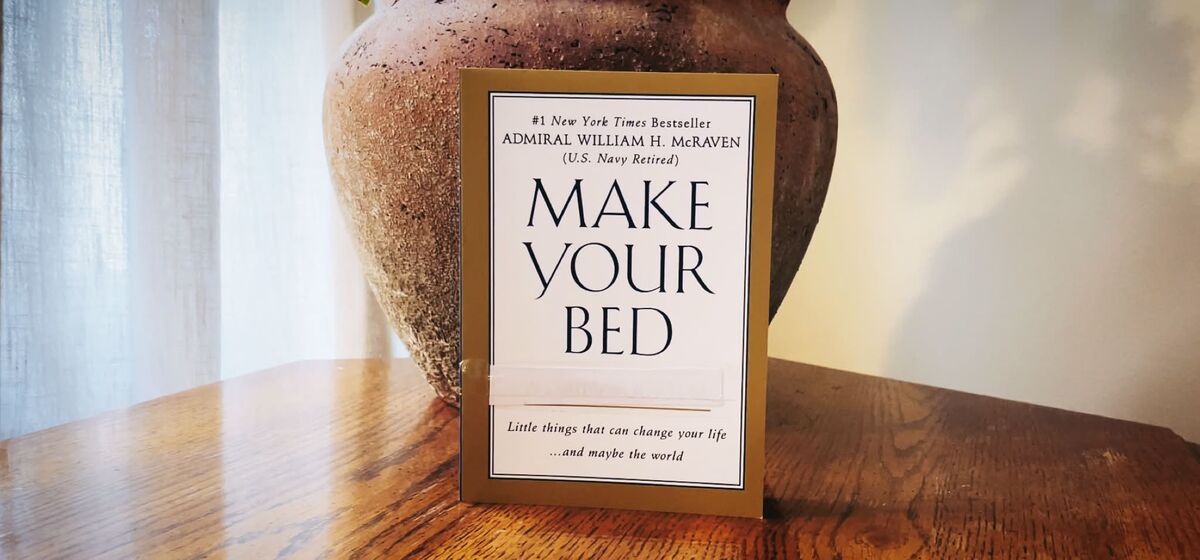
Make Your Bed
Ten life lessons from Navy SEAL training — simple enough for anyone, forged in the most extreme conditions imaginable.
What's It About?
Make Your Bed is based on a commencement speech by William H. McRaven, a former Navy SEAL, where he shares 10 lessons from SEAL training that are universal enough to apply to every person's life. The speech struck a chord with people, went viral, and got millions of views. In Make Your Bed he expands on each lesson with stories from life in America's toughest military training regime.
The lessons are simple and commonplace enough, but that doesn't diminish their value. The accompanying personal stories solidify what the mottos signify.
The 10 Lessons
1. Start Off by Making Your Bed
Start off your day with a completed task. Life is chaotic, your day will be filled with things that are beyond your control. Starting your day with completing something simple sets the trajectory for the rest of the day. If you can't do the small stuff, you will never be able to do the big stuff.
2. Find Someone to Help You Paddle
You can't go through life alone. Collaborate with people, make friends, find a partner. Teamwork is required. Don't forget that your success depends on others.
3. The Size of Your Heart
Determination and grit is more important than talent. SEAL training showed McRaven that it's not the size of your wallet, your skin color, or body type that matters — but the size of your heart.
4. Get Over Being a Sugar Cookie
Life is not fair. The sooner you realize this fact, the better. In SEAL training, the instructors — at random and without justification — ordered you to turn yourself into a sugar cookie: run into the water and then, wet from head to toe, roll around on the beach until you were fully covered in sand. You stayed that way for the rest of the day — wet, cold, and sandy. No reason given. That's life.
5. Don't Be Afraid of the Circuses
At SEAL training, the ones that failed to perform at drills were punished with extra training sessions. A vicious circle designed to make recruits give up. The extra hours of training made them even more exhausted, and their chances of succeeding at the next day's training diminished — causing even more extra training. This was called the Circus.
But if the recruits persisted through their rounds at the circus, something happened. They started to perform better. The extra training paid off, and now they were the ones finishing on top. The lesson: don't fear failure, but embrace it wholeheartedly.
📺 Video Review
6. Slide Down the Obstacle Head First
"Life is a struggle and the potential for failure is ever present, but those who live in fear of failure, or hardship, or embarrassment will never achieve their potential. Without pushing your limits, without occasionally sliding down the rope headfirst, without daring greatly, you will never know what is truly possible in your life."
To get to the next level you sometimes have to take calculated risks and overcome your fear and anxieties.
7. Don't Back Down from the Sharks
As a SEAL he had to swim in the ocean at night, and he knew there were sharks in the water. Maybe deep down. Maybe closer than that. But his mission and purpose were stronger than his fear. Belief in your goals gives you courage. And courage allows you to face sharks.
Bullies are everywhere. You need to be able to push towards your goal even if there are sharks. Don't let them hold you back.
8. Be Your Very Best in the Darkest Moment
Rise to the occasion. In the darkest moments you reach deep within and bring out your best.
9. Start Singing When You're Up to Your Neck in Mud
During Hell Week — the most challenging part of SEAL training, a week of constant drills, no sleep, and never-ending harassment from instructors — the easiest way to make the suffering stop is to quit. And you are urged to do so constantly. "Just quit, you can sit here by the fire with us. It's warm here. Look, we have food and warm clothes — all you have to do is say the word."
At the worst part of Hell Week, when you could tell that many were at the brink of giving up, one of the recruits started singing. Others chimed in. They were in this together, stood in unity, and wouldn't let anyone crush their spirits.
Hope can be a powerful way to inspire the people around you that tomorrow will be better and that the pain won't last.
10. Don't Ever, Ever Ring the Bell
You will face adversity, unbearable suffering, obstacles that seem insurmountable. Don't fall into the victim mentality, don't pity yourself. If you do, you will never overcome your shortcomings and succeed with your goals.
💡 Key Takeaway
The lessons in this book are universal, and apply to your life even if you are not a Navy SEAL. The reason we, regular people, don't learn these lessons as well as someone who went through something as challenging as SEAL training is because we spend less time at the extremes. It's at the extremes that universal truths make themselves known in a clear and simple way. That's why we can learn so much from these stories.
Because it's the same at the other extreme — when we slow down to zero, no thoughts, no actions, just stillness — other truths become obvious.
⚖️ Verdict
The issue I have with this book is not the lessons themselves, but that the short format just doesn't allow for the message to really sink in. A week after finishing it, I realized I forgot most of the book. Probably because it just let me stick my toe into each topic. It's a good book, and you might have a different experience, but I still want to leave you with some alternative reading that I found more lasting and impactful.
Try Can't Hurt Me by David Goggins for mindset and grit — also written by a SEAL, but one that really changed my life. Or A Guide to the Good Life by William Irvine for practical philosophy you can live by every day.