The Shelf That Changed My Mind
This is the corner of my library that changed how I think about everything. No hiding, no performance — just practical philosophy by people who were trying to figure out how to actually live. How to deal with stress, with failure, with the fact that we're all going to die. Light stuff, right?
These aren't self-help gurus. They're an emperor, a senator, a modern philosopher, and a concentration camp survivor — written across 2,000 years, on different continents, in completely different circumstances. And they all arrived at essentially the same conclusion.
📺 Watch the Library Tour
The Four Books
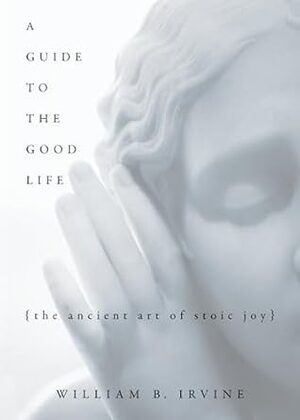
A Guide to the Good Life
This was my gateway book into philosophy and especially Stoicism. Most people get into Stoicism through Marcus Aurelius or Ryan Holiday — I got in through this one, and I think it's one of the better entry points. Irvine takes Stoicism and makes it really practical. It reads like a manual, not a lecture.
The idea that really stuck with me is negative visualization. It's not about being morbid — it's a way to appreciate what you have. Imagine vividly that you lose the things you love. Your home, your health, your kids. It's uncomfortable, but it makes you realize how much you already have. I've read this book three times and usually pick it up at the beginning of the year just to center and ground myself.
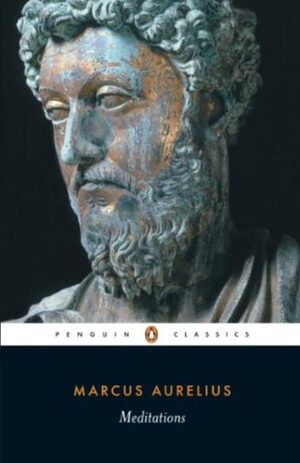
Meditations
After the Guide, I went to the actual source. This book was written almost 2,000 years ago by one of the most powerful men on the planet. He didn't write it for you. He didn't write it for anyone. It's a private journal — notes to himself on how not to lose his mind while running the Roman Empire.
What hits me is how familiar his problems feel. He writes about procrastination, about people annoying him, about not wanting to get out of bed in the morning. The things that annoy us today have been annoying people for thousands of years. If that doesn't give you perspective, nothing will.
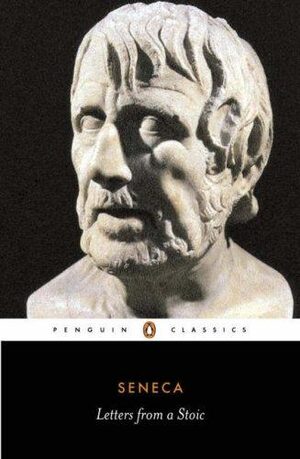
Letters from a Stoic
If Marcus Aurelius was the calm and steady emperor, Seneca was the messy one. He was one of the richest men in Rome, advisor to Nero — who was, let's say, a disaster of a person. In these gorgeous letters he writes about simplicity and detachment while being incredibly wealthy. That tension is what makes him real. He's not a monk on a mountain — he's a guy living in the real world, trying to live by his principles.
I think most of us live like Seneca. We know what we should do. We just struggle with actually doing it. He has this exercise where you deliberately practice poverty for a few days. Eat cheap food, sleep on hard surfaces — not as punishment, but so you can realize that the things you're afraid of losing aren't as essential as you think. I've tried it myself. It's uncomfortable, but it works.
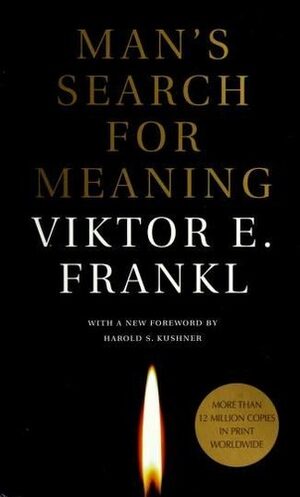
Man's Search for Meaning
I've read this book three times. It's one of very few books I keep coming back to. Frankl survived the Holocaust. He was a psychiatrist in a concentration camp. And he observed something profound: the people who survived weren't the strongest — they were the ones who had a reason to keep going. A purpose waiting on the other side.
"Those who have a why can bear almost any how."
That sounds like a poster quote until you know where it came from. This man had everything taken away from him and concluded that the last human freedom is choosing your attitude in life. That's not motivational fluff. That's someone who's been tested under the worst possible conditions imaginable.
💡 The Pattern
Here's what fascinates me. These four books were written across 2,000 years — by an emperor, a senator, a modern philosopher, and a concentration camp survivor. Different continents, different centuries, completely different circumstances. And they all arrived at essentially the same conclusion: you can't control what happens to you, but you can control what it means.
Reading them together gave me something none of them could give alone. Perspective on perspective itself. It's not just a nice idea — it's a pattern that keeps showing up across human history. And that tells me it's something fundamental about how we work.