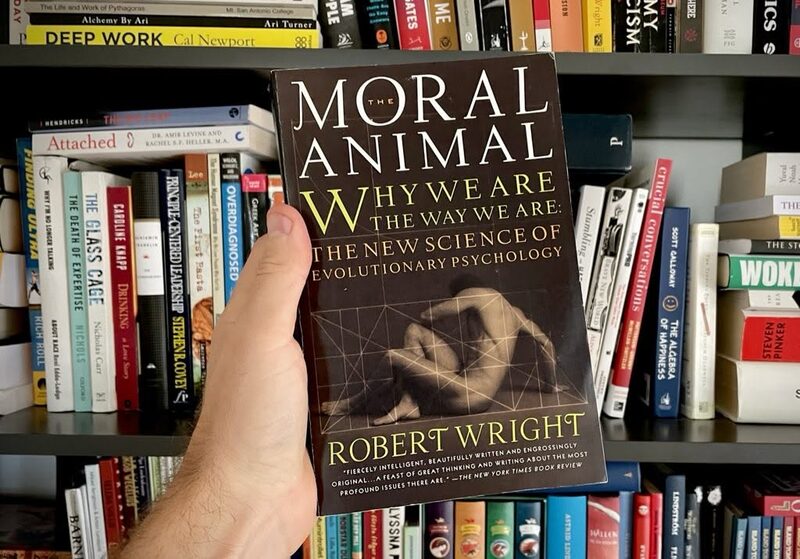
The Moral Animal
Evolutionary psychology can be harsh and uncomfortable. The logic of it might strike some as too Machiavellian to be a part of human nature. But to an evolutionary psychologist its cunning way adds credibility. Huxley has a great quote for this: "the indecency of the process is to a certain extent in favor of its probability."
The calculated ways in which we choose a suitable partner, child to prioritize in times of need, to whom we seek approval. It's all to further our own interests. Well, our gene's interest. And we are often so good at hiding our true intentions that we don't even know about them ourselves.
The Moral Animal is a seminal book about social dynamics and human relationships. In the book Robert Wright focuses on Darwinian explanations of why we are the way we are–emotionally and morally. And he does this by examining Charles Darwin's life and personal conduct in Victorian England–a society with strict social norms and moral values–and connecting it back to our evolutionary past.
Polygyny and Women
Male and Female Reproductive Strategies
In The Moral Animal, Wright shines a light on the genetic strategies behind everything from our sexual preferences to our office politics. And the answers are often provocative. One of those questions is: Does monogamy actually serve women's interests?
The Darwinian view indicates that men, consciously or unconsciously, want as many sex-providing and child-making machines as they can comfortably afford, and women, unconsciously or consciously, want to maximize the resources available to their children. Women prefer quality over quantity since they can only give birth to a very limited number of children.
Polygyny and Social Hierarchy
Polygamy is better for women. This thesis is only a thesis, but reality loosely fits it. In preindustrial societies, extreme polygamy goes often hand in hand with extreme hierarchy. In Zulu and Inca societies a man could have dozens of wives. And most societies, currently and in the recorded past, have been polygamous to some degree.
One theory is that as political power became distributed more evenly the hoarding of women became impractical.
"Few things are more anxiety-inducing for an elite governing class than gobs of sex-starved and childless men with at least a modicum of political power."
Why Learn About Evolutionary Psychology?
We have left the primitive world, updated our morals and rid ourselves of most threats to our daily survival. Actually, that's exactly why it is so important to understand evolutionary psychology. We are disconnected from our evolutionary past but the programming of the past still operates inside us.
It's not correct to say that people's minds are designed to maximize their fitness. "People's minds were designed to maximize fitness in the environment where those minds evolved." Understanding evolutionary psychology will help you notice when your primitive programming influences your behavior and gives you an opportunity to consciously override it.
Video Review
⭐️ Takeaway
One reason to read a lot is to figure out how to live in a world where our purpose of existence is to spread one's genes as effectively as possible. Evolution doesn't care about our wellbeing while we ceaselessly seek to produce successful offspring. Our evolutionary programming is not updated to support the needs of civilization.
That's where books come in. They can provide guides for how to live a good life, avoid unnecessary suffering and be useful to society, despite the underlying motivation from our genes.
⚖️ Verdict
This might not only be one of the best books about evolution's motives for human behavior, but also the best biography of Darwin's life. In this book both are combined. It's a fairly accessible book and instead of talking about evolutionary psychology in the abstract only, Wright makes an effort to turn the quirks of human nature into something that we can use in a practical and positive way in our lives.